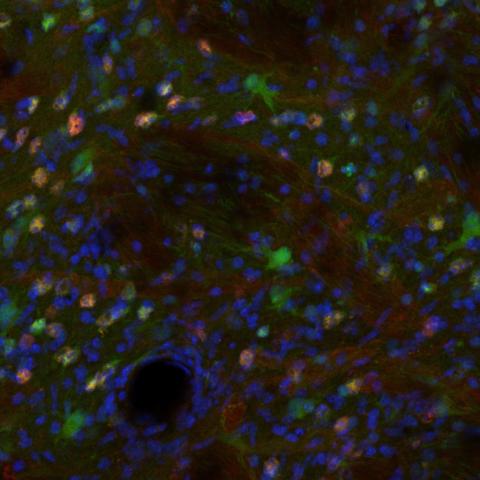
A team of researchers led by Prof Vincent Dion (UK DRI at Cardiff) has developed a promising new gene-editing approach that could transform the treatment of Huntington’s disease.
Huntington’s disease is a devastating neurodegenerative condition affecting movement, thinking and behaviour. It is caused by repetitive expansions of three DNA blocks (C, A and G) in the huntingtin gene. In people who have Huntington’s, this sequence gets longer throughout life until it becomes toxic to cells, leading to the progressive loss of neurons and accelerating neurodegeneration.
In the new study, published in Science Translational Medicine, researchers used a more precise gene-editing enzyme called Cas9 nickase, which cuts only a single strand of DNA within the repeated CAG/CTG sequences in mouse models of Huntington’s disease.
Traditional gene-editing techniques often cut both strands of DNA to disable mutated genes, but this can trigger unpredictable rearrangements, off-target mutations, or damage to healthy copies of the gene. Some researchers are also trying to apply these traditional gene-editing techniques to treating Huntington's disease in pre-clinical work, but they have limitations. We wanted to finesse this technique to explore whether there are more reliable potential genetic treatments for Huntington’s disease.
Group Leader
Prof Dion explained:
“The length of these repeated sequences accounts for most of the variation in how severe the disease is, so targeting and reducing these sequences is a potentially viable therapeutic avenue.
“Traditional gene-editing techniques often cut both strands of DNA to disable mutated genes, but this can trigger unpredictable rearrangements, off-target mutations, or damage to healthy copies of the gene. Some researchers are also trying to apply these traditional gene-editing techniques to treating Huntington's disease in pre-clinical work, but they have limitations.
“We wanted to finesse this technique to explore whether there are more reliable potential genetic treatments for Huntington’s disease.”
The team say no unwanted mutations were detected in brain cells in a dish with this approach, and it offers a potentially safer alternative to conventional gene-editing methods.
Prof Dion added: “When packaged into viral vectors and delivered directly to the striatum, the brain region primarily impacted by Huntington's disease, in a mouse model, the therapy shortened the DNA repeats in the majority of targeted neurons.
“This led to fewer toxic Huntington protein aggregates, restored healthier gene expression pathways in brain cells, and showed significant improvements in motor function during locomotion tests.”
The research was based on the CRISPR gene editing method and has potential application beyond Huntington’s disease in other genetic diseases caused by expanded repetitions in genetic codes.
Now, the team say more research is needed that involve optimising delivery methods to ensure stable, long-term expression of the editing tools without triggering immune responses, investigating whether treating animals at earlier stages can prevent neurodegenerative damage before symptoms ever appear, and conducting rigorous safety and efficiency testing in larger preclinical models to build the foundation for human clinical trials.
Prof Dion concluded:
“While much more research is needed – and our results only apply to mouse models of Huntington’s - these are exciting findings because there is currently no treatment for Huntington’s disease that changes the course of the disease. This could represent a novel therapeutic pathway through which we may be able to prevent the progression of – or effectively treat – Huntington’s disease.”
Links
Source: Cardiff University
Reference: Alvaro Murillo et al., Cas9 nickase–mediated contraction of CAG/CTG repeats is associated with phenotypic improvements in a Huntington’s disease mouse model.Sci. Transl. Med.18,eaef9466(2026).DOI:10.1126/scitranslmed.aef9466