Research led by Dr Audrey Chagnot, Dr Daniela Jaime Garcia, Dr Conor McQuaid and Dr Axel Montagne (UK DRI at Edinburgh & BHF-UK DRI Centre for Vascular Dementia Research) has uncovered distinct patterns of vascular damage in cerebral small vessel disease (cSVD). Published in Acta Neuropathologica, the study offers fresh clues about the biological changes associated with stroke and vascular dementia.
What was the challenge?
The brain relies on billions of tiny blood vessels to deliver oxygen and nutrients while protecting delicate brain tissue. But what happens to these vessels as we age and develop diseases that can lead to stroke and dementia? Long before the full extent of damage to the brain's smallest blood vessels becomes apparent, the cells that normally protect them may already be compromised.
What did the team do and what did they find?
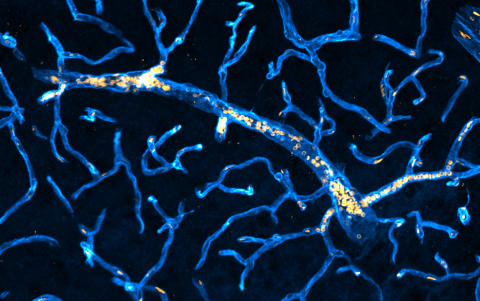
In this study, the team examined more than 10,000 microscopic blood vessel fragments from the brains of 20 donors, spanning different levels of disease severity.
They found that the loss of protective cells called pericytes and the activation of inflammatory processes in blood vessel walls do not always occur together. Some vessels showed signs of reduced pericyte coverage without substantial inflammatory activation, while others displayed both abnormalities.
Using advanced imaging and computational analysis, the researchers identified three distinct vascular patterns, revealing differences in blood vessel health that conventional assessments of disease severity may overlook.
We often think of small vessel disease as a single process that simply gets worse over time, but our findings suggest it’s far more nuanced. By looking at thousands of individual vessels, we could see that pericyte loss and inflammation don’t always go hand in hand, which points to different biological routes to damage.
Postdoctoral Researcher
What is the impact?
These findings suggest that damage to the brain's smallest blood vessels is more complex than previously appreciated and may involve different biological processes that could eventually be targeted therapeutically.
Although further research is needed to establish how these changes develop over time, the study provides a new framework for understanding the vascular damage associated with ageing, stroke, and dementia.
Reference: Chagnot, A., Jaime Garcia, D., McQuaid, C. et al. Pericyte loss and endothelial activation define distinct vascular states in cerebral small vessel disease. Acta Neuropathol 152, 53 (2026). https://doi.org/10.1007/s00401-026-03102-6