
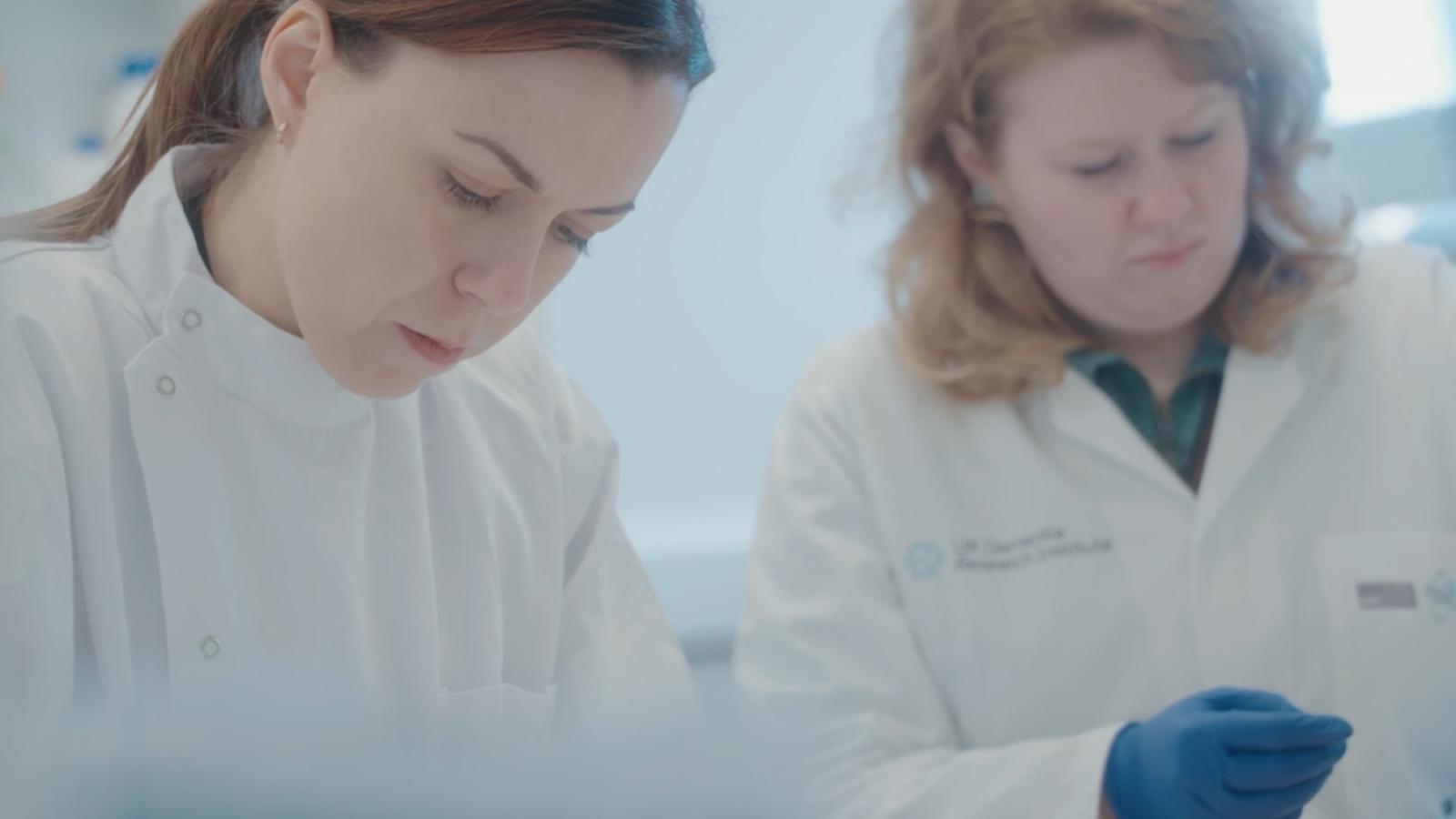
The Dementia Trials Accelerator has taken a significant step towards transforming dementia clinical trials in the UK by welcoming its first participants into clinics for simple tests that will ultimately get the right people into clinical trials quicker, speeding up vital research.
Led by the UK DRI and Health Data Research UK (HDR UK), the Dementia Trials Accelerator (DTA) aims to address one of the biggest barriers to progress in dementia research: the chronic under-recruitment to clinical trials. In some cases, it can take up to three years to recruit enough participants to run an 18-month dementia trial – while the average cancer trial takes 2.3 years from start to completion, including the recruitment phase.
Over 12,000 participants aged 65-75 from REACT – one of the UK’s largest cohort studies involving 2.7 million adults and led by Imperial College London – have been invited to the first clinics run by the DTA’s delivery partner, Inuvi. Those that come forward undertake cognitive tests and provide a blood sample, as well as having their height, weight, and blood pressure measured. Blood samples are then tested for biomarkers that have been linked to dementia risk. More than 700 people have taken part in just the first few weeks.
By early 2027, the DTA aims to have over 10,000 participants who want to take part in future research to combat this devastating disease. Currently, participation in the DTA is by invitation only to eligible participants already involved in the REACT study.
Susie, 75, a participant in the Dementia Trials Accelerator, said:
“My mother was diagnosed with Alzheimer's disease. Watching her deteriorate with no prospect of a cure was heartbreaking for the whole family. Also, as a retired GP I witnessed first-hand the struggles that those diagnosed with dementia and their loved ones go through.
“I have three sisters and I am very aware that any one of us could follow the path of our mother. This is why I feel so strongly about taking part in research. It is a devastating disease, but we need to tackle it head on.”
Increasing the number of people involved in clinical trials, as well as the speed at which the right people are found, is vital to improving diagnosis and treatments for those affected by dementia. The information gathered from Dementia Trials Accelerator participants is linked to clinical survey data and stored safely and securely on a platform where approved clinical trialists can find willing participants much more quickly and easily.
Prof Andrew Morris, Director of Health Data Research UK, said:
“For too long, dementia trials have been held back by the difficulty of enrolling enough participants. The Dementia Trials Accelerator unites patients, universities, two national research institutes and the private sector in a powerful partnership. Together, we will speed up the complex process of identifying and recruiting the right people for dementia clinical trials across the UK – accelerating the search for new treatments, earlier diagnosis and better care.”

Dementia research is at a tipping point, and advances in biomarker research are integral to this. We can now identify the biological signatures of disease more accurately than ever before, enabling earlier diagnosis and more personalised approaches to treatment. The Dementia Trials Accelerator harnesses this, embedding robust biomarker testing at its core to ensure the right participants can be matched to the right trials. Scaling up clinical trial participation will turbo charge dementia research and bring us closer to transforming the outlook for everyone affected by neurodegenerative conditions.
Funded by £20 million from the Medical Research Council, the DTA is delivering on the government’s life science and health ambitions, supporting the Dame Barbara Windsor Dementia Goals programme to develop innovative research tools and boost the number of clinical trials in dementia and neurodegeneration. This initiative will accelerate our understanding of these conditions and transform the lives of people at risk of dementia.
Dr Zubir Ahmed, Health Innovation and Safety Minister, said:
“Dementia affects nearly one million people in the UK, and for too long our ability to find new treatments has been held back by the sheer difficulty of recruiting enough people to clinical trials.
“This Government is changing that. By bringing together world-class researchers and the power of health data, we are building a pipeline of people who are ready and willing to take part in the trials that will shape the treatments of the future and hopefully transform the lives of patients for generations to come.
“This is exactly the kind of innovation that our 10 Year Health Plan was designed to drive, and I am proud that the UK is leading the way in turning scientific ambition into real progress for patients and their families.”
The DTA is currently invitation only for existing participants of the REACT study. If others would like to take part in a clinical trial, they can register interest at Join Dementia Research.