
Search
Main content

Prof Siddharthan Chandran

Director & CEO

Dissecting a genetic cause of ALS and FTD and identifying ways to help protect neurons

Biography

Professor Siddharthan Chandran is Director of the UK Dementia Research Institute, and an internationally leading expert in neurodegenerative diseases. Prof Chandran is a practising neurologist and scientist working at the forefront of the emerging discipline of Regenerative Neurology, renowned for his work in motor neuron disease (MND) and MS that combines laboratory and clinical research with a particular focus on human / patient stem cells for his discovery science research. Alongside his UK DRI research, Prof Chandran is Director of the Euan MacDonald Centre for Motor Neuron Disease Research and the Anne Rowling Regenerative Neurology Clinic at the University of Edinburgh. He is also a Fellow of the Royal Society of Edinburgh and the Academy of Medical Sciences.
News

Key publications

Acta Neuropathol
Published

Mitochondrial bioenergetic deficits in C9orf72 amyotrophic lateral sclerosis motor neurons cause dysfunctional axonal homeostasis.

Authors
Arpan R Mehta, Jenna M Gregory, Owen Dando, Roderick N Carter, Karen Burr, Jyoti Nanda, David Story, Karina McDade, Colin Smith, Nicholas M Morton, Don J Mahad, Giles E Hardingham, Siddharthan Chandran, Bhuvaneish T Selvaraj
Mitochondrial bioenergetic deficits in C9orf72 amyotrophic lateral sclerosis motor neurons cause dysfunctional axonal homeostasis.
Acta Neuropathol
Published

Mitochondrial bioenergetic deficits in C9orf72 amyotrophic lateral sclerosis motor neurons cause dysfunctional axonal homeostasis.

Authors
Arpan R Mehta, Jenna M Gregory, Owen Dando, Roderick N Carter, Karen Burr, Jyoti Nanda, David Story, Karina McDade, Colin Smith, Nicholas M Morton, Don J Mahad, Giles E Hardingham, Siddharthan Chandran, Bhuvaneish T Selvaraj
Mitochondrial bioenergetic deficits in C9orf72 amyotrophic lateral sclerosis motor neurons cause dysfunctional axonal homeostasis.
Brain Commun
Published

Clinical trials in amyotrophic lateral sclerosis: a systematic review and perspective.

Authors
Charis Wong, Maria Stavrou, Elizabeth Elliott, Jenna M Gregory, Nigel Leigh, Ashwin A Pinto, Timothy L Williams, Jeremy Chataway, Robert Swingler, Mahesh K B Parmar, Nigel Stallard, Christopher J Weir, Richard A Parker, Amina Chaouch, Hisham Hamdalla, John Ealing, George Gorrie, Ian Morrison, Callum Duncan, Peter Connelly, Francisco Javier Carod-Artal, Richard Davenport, Pablo Garcia Reitboeck, Aleksandar Radunovic, Venkataramanan Srinivasan, Jenny Preston, Arpan R Mehta, Danielle Leighton, Stella Glasmacher, Emily Beswick, Jill Williamson, Amy Stenson, Christine Weaver, Judith Newton, Dawn Lyle, Rachel Dakin, Malcolm Macleod, Suvankar Pal, Siddharthan Chandran
Clinical trials in amyotrophic lateral sclerosis: a systematic review and perspective.
J Clin Invest
Published

Truncated stathmin-2 is a marker of TDP-43 pathology in frontotemporal dementia.

Authors
Mercedes Prudencio, Jack Humphrey, Sarah Pickles, Anna-Leigh Brown, Sarah E Hill, Jennifer M Kachergus, J Shi, Michael G Heckman, Matthew R Spiegel, Casey Cook, Yuping Song, Mei Yue, Lillian M Daughrity, Yari Carlomagno, Karen Jansen-West, Cristhoper Fernandez de Castro, Michael DeTure, Shunsuke Koga, Ying-Chih Wang, Prasanth Sivakumar, Cristian Bodo, Ana Candalija, Kevin Talbot, Bhuvaneish T Selvaraj, Karen Burr, Siddharthan Chandran, Jia Newcombe, Tammaryn Lashley, Isabel Hubbard, Demetra Catalano, Duyang Kim, Nadia Propp, Samantha Fennessey, , Delphine Fagegaltier, Hemali Phatnani, Maria Secrier, Elizabeth Mc Fisher, Björn Oskarsson, Marka van Blitterswijk, Rosa Rademakers, Neil R Graff-Radford, Bradley F Boeve, David S Knopman, Ronald C Petersen, Keith A Josephs, E Aubrey Thompson, Towfique Raj, Michael Ward, Dennis W Dickson, Tania F Gendron, Pietro Fratta, Leonard Petrucelli
Truncated stathmin-2 is a marker of TDP-43 pathology in frontotemporal dementia.

Chandran Lab

Explore the work of the Chandran Lab, Dissecting a genetic cause of ALS and FTD and identifying ways to help protect neurons.
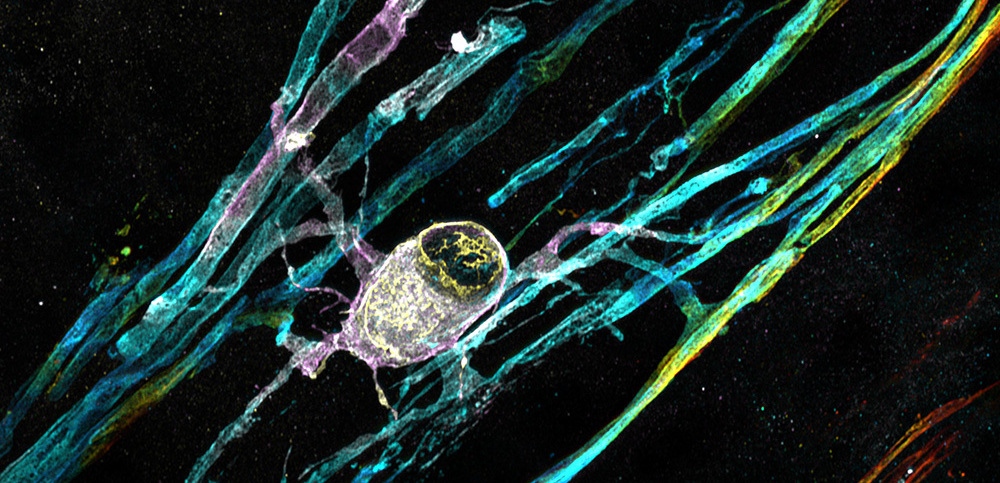
 
Human stem cell-derived myelinating oligodendrocyte can be seen with many myelinating processes wrapped around unstained neurons