
Search
Main content
Siddharthan Chandran

Prof Siddharthan Chandran

Director & CEO

Dissecting a genetic cause of ALS and FTD and identifying ways to help protect neurons

Biography

Professor Siddharthan Chandran is Director of the UK Dementia Research Institute, and an internationally leading expert in neurodegenerative diseases. Prof Chandran is a practising neurologist and scientist working at the forefront of the emerging discipline of Regenerative Neurology, renowned for his work in motor neuron disease (MND) and MS that combines laboratory and clinical research with a particular focus on human / patient stem cells for his discovery science research. Alongside his UK DRI research, Prof Chandran is Director of the Euan MacDonald Centre for Motor Neuron Disease Research and the Anne Rowling Regenerative Neurology Clinic at the University of Edinburgh. He is also a Fellow of the Royal Society of Edinburgh and the Academy of Medical Sciences.
News

Key publications

Nat Commun
Published
Astrocyte-oligodendrocyte interaction regulates central nervous system regeneration.
Authors
Irene Molina-Gonzalez, Rebecca K Holloway, Zoeb Jiwaji, Owen Dando, Sarah A Kent, Katie Emelianova, Amy F Lloyd, Lindsey H Forbes, Ayisha Mahmood, Thomas Skripuletz, Viktoria Gudi, James A Febery, Jeffrey A Johnson, Jill H Fowler, Tanja Kuhlmann, Anna Williams, Siddharthan Chandran, Martin Stangel, Andrew J M Howden, Giles E Hardingham, Veronique E Miron
Astrocyte-oligodendrocyte interaction regulates central nervous system regeneration.
Sci Adv
Published
Cell-autonomous immune dysfunction driven by disrupted autophagy in C9orf72-ALS iPSC-derived microglia contributes to neurodegeneration.
Authors
Poulomi Banerjee, Arpan R Mehta, Raja S Nirujogi, James Cooper, Owen G James, Jyoti Nanda, James Longden, Karen Burr, Karina McDade, Andrea Salzinger, Evdokia Paza, Judith Newton, David Story, Suvankar Pal, Colin Smith, Dario R Alessi, Bhuvaneish T Selvaraj, Josef Priller, Siddharthan Chandran
Cell-autonomous immune dysfunction driven by disrupted autophagy in C9orf72-ALS iPSC-derived microglia contributes to neurodegeneration.
BMJ Open
Published
Systematic, comprehensive, evidence-based approach to identify neuroprotective interventions for motor neuron disease: using systematic reviews to inform expert consensus.
Authors
Charis Wong, Jenna M Gregory, Jing Liao, Kieren Egan, Hanna M Vesterinen, Aimal Ahmad Khan, Maarij Anwar, Caitlin Beagan, Fraser S Brown, John Cafferkey, Alessandra Cardinali, Jane Yi Chiam, Claire Chiang, Victoria Collins, Joyce Dormido, Elizabeth Elliott, Peter Foley, Yu Cheng Foo, Lily Fulton-Humble, Angus B Gane, Stella A Glasmacher, Áine Heffernan, Kiran Jayaprakash, Nimesh Jayasuriya, Amina Kaddouri, Jamie Kiernan, Gavin Langlands, D Leighton, Jiaming Liu, James Lyon, Arpan R Mehta, Alyssa Meng, Vivienne Nguyen, Na Hyun Park, Suzanne Quigley, Yousuf Rashid, Andrea Salzinger, Bethany Shiell, Ankur Singh, Tim Soane, Alexandra Thompson, Olaf Tomala, Fergal M Waldron, Bhuvaneish T Selvaraj, Jeremy Chataway, Robert Swingler, Peter Connick, Suvankar Pal, Siddharthan Chandran, Malcolm Macleod
Systematic, comprehensive, evidence-based approach to identify neuroprotective interventions for motor neuron disease: using systematic reviews to inform expert consensus.

Chandran Lab

Explore the work of the Chandran Lab, Dissecting a genetic cause of ALS and FTD and identifying ways to help protect neurons.
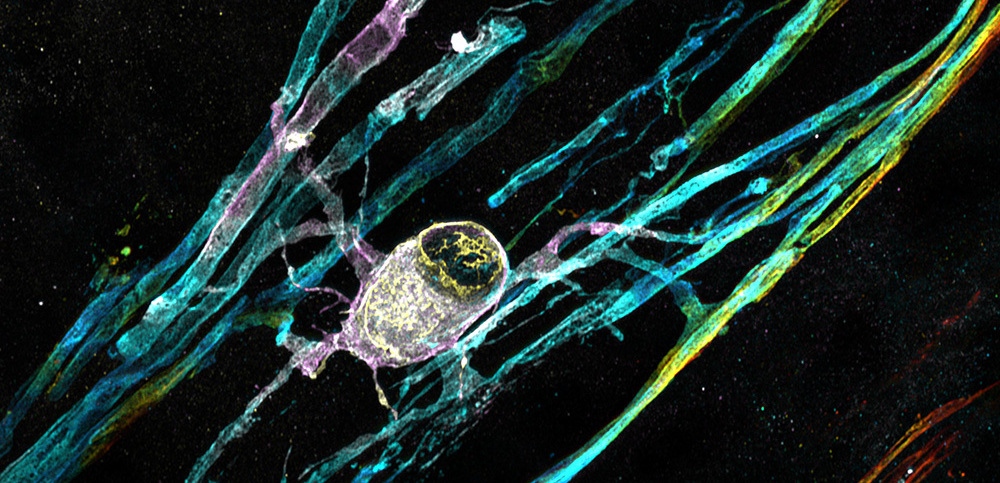
 
Human stem cell-derived myelinating oligodendrocyte can be seen with many myelinating processes wrapped around unstained neurons