
Search
Main content
Siddharthan Chandran

Prof Siddharthan Chandran

Director & CEO

Dissecting a genetic cause of ALS and FTD and identifying ways to help protect neurons

Biography

Professor Siddharthan Chandran is Director of the UK Dementia Research Institute, and an internationally leading expert in neurodegenerative diseases. Prof Chandran is a practising neurologist and scientist working at the forefront of the emerging discipline of Regenerative Neurology, renowned for his work in motor neuron disease (MND) and MS that combines laboratory and clinical research with a particular focus on human / patient stem cells for his discovery science research. Alongside his UK DRI research, Prof Chandran is Director of the Euan MacDonald Centre for Motor Neuron Disease Research and the Anne Rowling Regenerative Neurology Clinic at the University of Edinburgh. He is also a Fellow of the Royal Society of Edinburgh and the Academy of Medical Sciences.

News

- Event

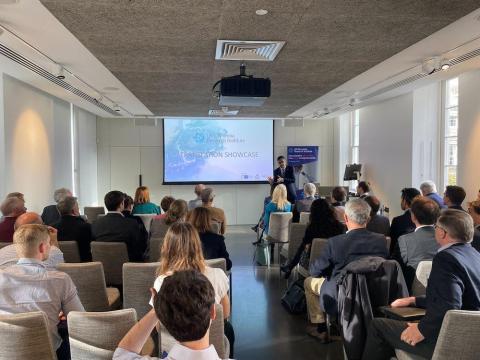
Translation Showcase: breakthroughs to benefits

This month, we invited industry partners and stakeholders to an exciting Translation Showcase event at...

Learn more Translation Showcase: breakthroughs to benefits

Key publications

Nat Commun
Published
Reactive astrocytes acquire neuroprotective as well as deleterious signatures in response to Tau and Aß pathology.
Authors
Zoeb Jiwaji, Sachin S Tiwari, Rolando X Avilés-Reyes, Monique Hooley, David Hampton, Megan Torvell, Delinda A Johnson, Jamie McQueen, Paul Baxter, Kayalvizhi Sabari-Sankar, Jing Qiu, Xin He, Jill Fowler, James Febery, Jenna Gregory, Jamie Rose, Jane Tulloch, Jamie Loan, David Story, Karina McDade, Amy M Smith, Peta Greer, Matthew Ball, Peter C Kind, Paul M Matthews, Colin Smith, Owen Dando, Tara L Spires-Jones, Jeffrey A Johnson, Siddharthan Chandran, Giles E Hardingham
Reactive astrocytes acquire neuroprotective as well as deleterious signatures in response to Tau and Aß pathology.
Brain Commun
Published
Clinical trials in amyotrophic lateral sclerosis: a systematic review and perspective.
Authors
Charis Wong, Maria Stavrou, Elizabeth Elliott, Jenna M Gregory, Nigel Leigh, Ashwin A Pinto, Timothy L Williams, Jeremy Chataway, Robert Swingler, Mahesh K B Parmar, Nigel Stallard, Christopher J Weir, Richard A Parker, Amina Chaouch, Hisham Hamdalla, John Ealing, George Gorrie, Ian Morrison, Callum Duncan, Peter Connelly, Francisco Javier Carod-Artal, Richard Davenport, Pablo Garcia Reitboeck, Aleksandar Radunovic, Venkataramanan Srinivasan, Jenny Preston, Arpan R Mehta, Danielle Leighton, Stella Glasmacher, Emily Beswick, Jill Williamson, Amy Stenson, Christine Weaver, Judith Newton, Dawn Lyle, Rachel Dakin, Malcolm Macleod, Suvankar Pal, Siddharthan Chandran
Clinical trials in amyotrophic lateral sclerosis: a systematic review and perspective.
Sci Adv
Published
C9orf72-derived arginine-containing dipeptide repeats associate with axonal transport machinery and impede microtubule-based motility.
Authors
Laura Fumagalli, Florence L Young, Steven Boeynaems, Mathias De Decker, Arpan R Mehta, Ann Swijsen, Raheem Fazal, Wenting Guo, Matthieu Moisse, Jimmy Beckers, Lieselot Dedeene, Bhuvaneish T Selvaraj, Tijs Vandoorne, Vanesa Madan, Marka van Blitterswijk, Denitza Raitcheva, Alexander McCampbell, Koen Poesen, Aaron D Gitler, Philipp Koch, Pieter Vanden Berghe, Dietmar Rudolf Thal, Catherine Verfaillie, Siddharthan Chandran, Ludo Van Den Bosch, Simon L Bullock, Philip Van Damme
C9orf72-derived arginine-containing dipeptide repeats associate with axonal transport machinery and impede microtubule-based motility.
Mol Neurodegener
Published
Altered network properties in C9ORF72 repeat expansion cortical neurons are due to synaptic dysfunction.
Authors
Emma M Perkins, Karen Burr, Poulomi Banerjee, Arpan R Mehta, Owen Dando, Bhuvaneish T Selvaraj, Daumante Suminaite, Jyoti Nanda, Christopher M Henstridge, Thomas H Gillingwater, Giles E Hardingham, David J A Wyllie, Siddharthan Chandran, Matthew R Livesey
Altered network properties in C9ORF72 repeat expansion cortical neurons are due to synaptic dysfunction.

Chandran Lab

Explore the work of the Chandran Lab, Dissecting a genetic cause of ALS and FTD and identifying ways to help protect neurons.
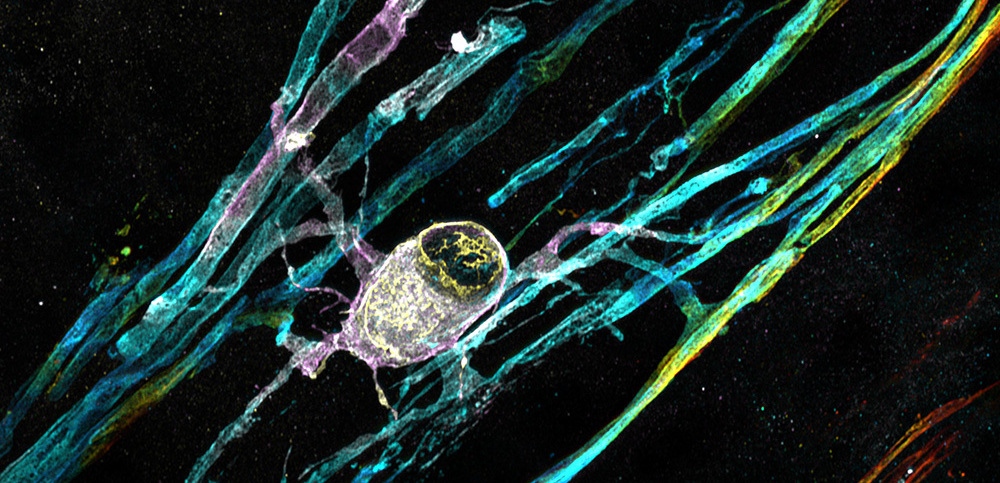
 
Human stem cell-derived myelinating oligodendrocyte can be seen with many myelinating processes wrapped around unstained neurons