
Biography
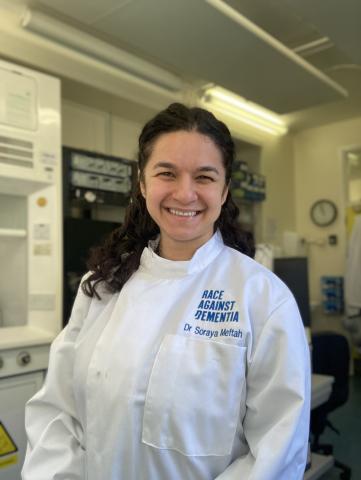
Dr Soraya Meftah spent a placement year during her BSc working as a research assistant at the CNRS in Lyon, where she examined the effect of REM sleep deprivation on cataplexy in a model of narcolepsy with Dr Christelle Peyron. Prior to her PhD, Soraya worked at Eli Lilly and Company as a molecular pathologist with a focus on drug discovery for neurodegenerative diseases. She then went on to do her PhD with Dr Jon Brown, Dr Jon Witton & Dr Michael Ashby, examining synaptic and neuronal dysfunction in a model of tauopathy using in vivo and in vitro whole-cell patch clamp electrophysiology, histology, and molecular biology techniques. Following this, she worked with Dr Jian Gan as a postdoctoral research fellow, characterising dysfunction in models of dementia using simultaneous in vivo whole-cell patch clamp recordings alongside LFP and other techniques. She was then employed as a postdoctoral research fellow with Dr Claire Durrant, developing human and rodent organotypic models of dementia. Currently, she is an ARUK-RAD Senior Research Fellow using translatable complementary models (mouse, human) to investigate functional signatures of Alzheimer’s disease and other diseases that cause dementia. To do this, she takes a multidisciplinary approach, generating multimodal datasets in multiple model systems and applying complex analysis methodologies such as AI to facilitate this.
Honours & awards
*Women In Neuroscience Rising Star: postdoctoral award, 2025, finalist.
*University of Edinburgh CMVM postdoc appreciation week prize, 2025, for contributions to scientific advancement.
*De Laszlo Prize at ARUK 2024, highlighting exceptional ECR speakers selected for main conference talks.
*SULSA Postdoctoral Prize 2024, shortlisted.
*University of Edinburgh CMVM Team Excellence Award 2024, runner up as part of the Live Human Brain Tissue Research Team.
*UKDRI 3Rs Prize 2024, as part of the Live Human Brain Tissue Research Team.
*Poster Prize at GW4 Early Career Neuroscience Day 2019.
Research interest
My work looks at dysfunction of the brain in dementia, in particular related to electrophysiological changes, but also multi-modal profiles of dysfunction and how we can use novel modalities to treat this