Biography
Tara Spires-Jones, DPhil(Oxon), FMedSci, FRSE is the Professor of Neurodegeneration at the University of Edinburgh, Past President of the British Neuroscience Association, and co-Leads the synapses, circuits, cognition and physiology division in the UK Dementia Research Institute. Her research focuses on the mechanisms and reversibility of synapse degeneration in Alzheimer’s disease and related neurodegenerative conditions.
Prof Spires-Jones trained in Biochemistry and French at the University of Texas at Austin as an undergraduate and earned a masters and DPhil from the University of Oxford supervised by Prof Sir Colin Blakemore and Prof Anthony Hannan. She then moved to Massachusetts General Hospital and Harvard Medical School for postdoctoral training with Prof Bradley Hyman where she stayed and started a group as Instructor then and Assistant Professor In 2013 she moved to the University of Edinburgh.
In addition to her research, Prof Spires-Jones is passionate about communicating scientific findings to the public and policy makers; increasing the rigour and reproducibility in translational neuroscience; promoting inclusivity and diversity in science; and supporting career development of neuroscientists.
Honours & awards
2026 Elected as a Fellow of the Royal Society of Edinburgh
2026 Awarded the Alzheimer’s Research UK 2026 Stuart Pickering Brown Prize for lifetime achievement in dementia research
2025 Invited Presidential Lecture at the Society for Neuroscience 2025 Conference, San Diego, USA, 21,000 attendees
2024 Elected Fellow of the UK national Academy of Medical Sciences
2024 Inge Grundke-Iqbal Award for Alzheimer’s Research, Awarded by the Alzheimer’s Association for the most influential paper in the Alzheimer’s field for the previous 2 years
2024 Women in Neuroscience UK Prize for Ageing and Neuropathology Leading Researcher of the Year
2022 Highly Cited Researcher List, Clarivate
2022 Nominated for a teaching award for Best Personal Tutor, Edinburgh University Students’ Association
2018 Elected Term Member of the European Dana Alliance for the Brain
2018 Nominated for best course and best research supervisor teaching awards, Edinburgh University Students’ Association
2014 Elected as a founding FENS-Kavli Network of Excellence Scholar (one of 20 in Europe)
2013 Aurora Leadership Foundation Training –promoting women leaders in higher education
2003 Peter Beaconsfield Prize in Physiological Sciences – University of Oxford
2003 Young Investigator Award – Gordon Research Conference
2001 National Science Foundation Graduate Research Fellowship (Graduate funding award)
1999 British Marshall Scholarship (Graduate funding award)
1994 National Merit Scholarship (Undergraduate funding award)
News

Research interest
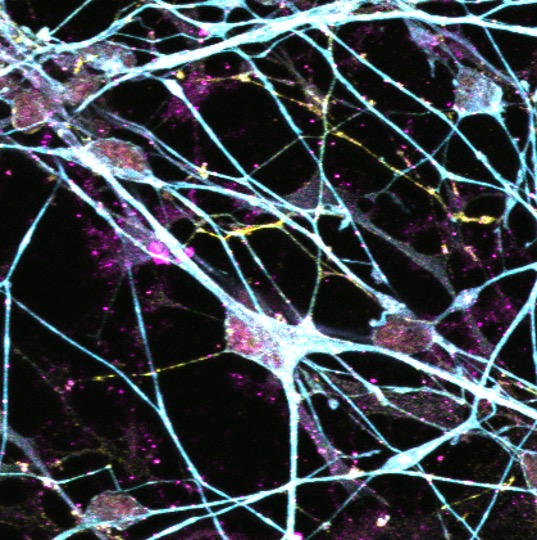
Professor Tara Spires-Jones, DPhil(Oxon), FMedSci, FRSE is a world leader in dementia research, working in the field for over 20 years investigating the brain changes that cause Alzheimer’s disease and related dementias. She discovered that synapses, the connections between neurons, are damaged by pathological proteins that accumulate in the brains of people with dementias, and that pathology spreads through the brain by jumping through these synaptic connections. She has published over 200 research papers that have been cited more than 25,000 times.
Key publications
Links
Spires-Jones Lab
Explore the work of the Spires-Jones Lab focused on deciphering why synapses and neurons degenerate and whether boosting resilience of synapses can protect the brain.