
Search
Main content
Giles Hardingham

Prof Giles Hardingham

Centre Director & Directors' Counsel

Studying astrocytes to better understand their role in helping maintain a healthy brain

Biography

An expert in cell signalling, Prof Giles Hardingham is The City of Edinburgh Professor of Pharmacology at the University of Edinburgh. Giles obtained his PhD from the MRC Laboratory of Molecular Biology in 1998, subsequently trained as an MRC postdoctoral researcher, before moving to the University of Edinburgh in 2002 as a Royal Society University Research Fellow. He became Professor of Molecular Neurobiology and a MRC Senior Research Fellow in 2010, and was elected Fellow of The Academy of Medical Sciences and the Royal Society of Edinburgh in 2018. As Centre Director of the UK DRI at Edinburgh, he oversees an exciting programme of research and lead work investigating astrocytes in neurodegenerative diseases.

News

Key publications

Neuropathology and applied neurobiology
Published
Synaptic gene expression changes in frontotemporal dementia due to the MAPT 10 + 16 mutation
Authors
Owen Dando, Robert McGeachan, Jamie McQueen, Paul Baxter, Nathan Rockley, Hannah McAlister, Adharsh Prasad, Xin He, Declan King, Jamie Rose, Phillip B Jones, Jane Tulloch, Siddharthan Chandran, Colin Smith, Giles Hardingham, Tara L Spires-Jones
Synaptic gene expression changes in frontotemporal dementia due to the MAPT 10 + 16 mutation
Cell Reports Medicine
Published
Human astrocytes and microglia show augmented ingestion of synapses in Alzheimer's disease via MFG-E8
Authors
Makis Tzioras, Michael J.D. Daniels, Caitlin Davies, Paul Baxter, Declan King, Sean McKay, Balazs Varga, Karla Popovic, Madison Hernandez, Anna J. Stevenson, Jack Barrington, Elizabeth Drinkwater, Julia Borella, Rebecca K. Holloway, Jane Tulloch, Jonathan Moss, Clare Latta, Jothy Kandasamy, Drahoslav Sokol, Colin Smith, Veronique E. Miron, Ragnhildur Thóra Káradóttir, Giles E. Hardingham, Christopher M. Henstridge, Paul M. Brennan, Barry W. McColl, Tara L. Spires-Jones
Human astrocytes and microglia show augmented ingestion of synapses in Alzheimer's disease via MFG-E8
Cell Reports
Published
Amyloid Beta and Tau Cooperate to Cause Reversible Behavioral and Transcriptional Deficits in a Model of Alzheimer's Disease
Authors
Eleanor K. Pickett, Abigail G. Herrmann, Jamie McQueen, Kimberly Abt, Owen Dando, Jane Tulloch, Pooja Jain, Sophie Dunnett, Sadaf Sohrabi, Maria P. Fjeldstad, Will Calkin, Leo Murison, Rosemary J. Jackson, Makis Tzioras, Anna Stevenson, Marie d'Orange, Monique Hooley, Caitlin Davies, Marti Colom-Cadena, Alejandro Anton-Fernandez, Declan King, Iris Oren, Jamie Rose, Chris-Anne McKenzie, Elizabeth Allison, Colin Smith, Oliver Hardt, Christopher M. Henstridge, Giles E. Hardingham, Tara L. Spires-Jones
Amyloid Beta and Tau Cooperate to Cause Reversible Behavioral and Transcriptional Deficits in a Model of Alzheimer's Disease

Hardingham Lab

Explore the work of the Hardingham Lab, studying astrocytes to better understand their role in helping maintain a healthy brain.
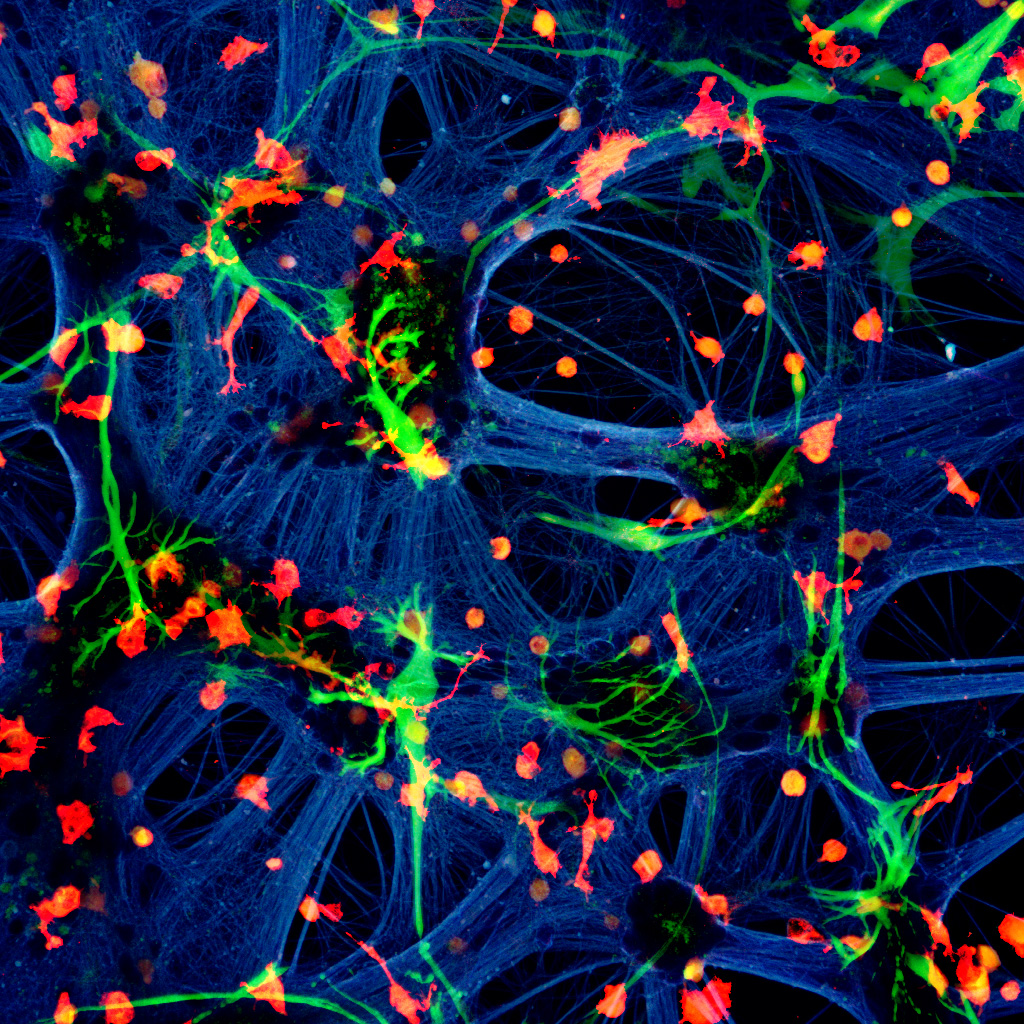
 
 
Mixed species co-culture