
Key details
New ways to detect and monitor Parkinson’s disease
The Sandor Lab aims to develop new ways to detect and monitor Parkinson’s disease (PD) earlier, even before the typical motor symptoms, like tremors, appear. By the time these symptoms show up, a large portion of brain cells responsible for movement has already been damaged, making it harder to treat the disease effectively. The team want to find clues that show the disease is developing much earlier, which could help intervene sooner.
To do this, the Sandor Lab will use data from smartwatches that track non-motor symptoms of PD, such as sleep problems, depression, or changes in blood pressure, which often appear years before the disease is diagnosed. They will also study specific markers in the blood that may indicate early changes related to PD. Finally, we’ll use electronic health records to explore whether any common drugs taken for other conditions might slow down the progression of PD.
This research is important because it could lead to earlier diagnosis, more effective treatments, and even new drugs that slow the disease’s progression, improving the quality of life for millions of people affected by Parkinson’s worldwide.
Latest news
Dr Cynthia Sandor
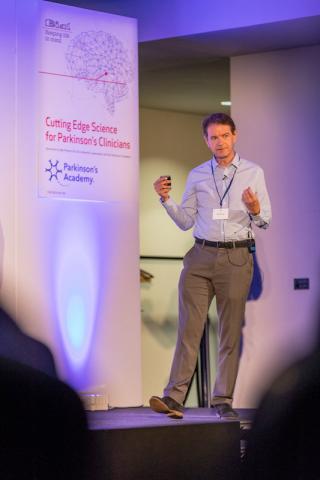
Dr Cynthia Sandor is a Group Leader at the UK DRI at Imperial. Find out more about her career and expertise on her profile page.

Research summary

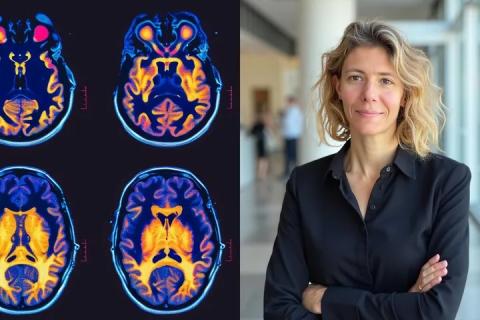
Dr Cynthia Sandor used smart watch data from UK Biobank to identify Parkinson’ up to seven years before hallmark symptoms appeared and a clinical diagnosis can be made. Credit: Shutterstock/Domanin
Harnessing digital biomarkers, molecular markers, and Big Data to unlock insights in early detection and progression in Parkinson’s
Currently, there is no cure or treatment available to slow the progression of Parkinson’s disease (PD). Research has primarily focused on individuals with a clinical diagnosis of PD, which is contingent on the presence of motor symptoms. By the time these symptoms appear, up to 50% of dopaminergic neurons—essential for movement—are already lost. Various non-motor symptoms, such as REM Sleep Behavior Disorder, depression, orthostatic hypotension, anosmia, and constipation, have been identified up to 10 years before diagnosis, in what is known as the prodromal phase.
The goal of this research program is to understand the molecular mechanisms underlying these early symptoms, which could pave the way for neuroprotective treatments. We will use large-scale data, including Electronic Health Records (EHR), deeply phenotyped cohorts different omics dataset, digital biomarkers, while leveraging advanced computional approach methods to take avantage of these dataset such as large language models or transfer learning.
Research objectives:
Identify early non-motor symptoms in the general population using digital biomarkers.
This research will focus on developing digital markers that can predict these non-motor symptoms, leveraging data from smartwatch data. The Sandor Lab have shown it is possible to identify such symptoms using one week of accelerometer data, and their objective is to further refine this approach.
Identify specific blood molecular markers that precede a clinical diagnosis.
There is growing evidence that PD pathology may begin in the enteric or peripheral autonomic nervous system and then spread to the brain. This suggests that peripheral immune system changes may precede brain involvement. The goal of the team is to establish blood-based immune markers that correlate with early non-motor symptoms, which could help identify PD earlier. The Sandor Lab will use omics data from both human and mouse models, including bulk and single-cell transcriptomics as well as proteomics, to assess how these blood signatures relate to neurodegeneration.
Identify non-Parkinson’s drugs that alter PD progression using EHR.
A promising approach to discovering new treatments is identifying non-Parkinson’s medications that may modify the disease through off-target effects. To explore this, the Sandor Lab will analyse EHR data from the Clinical Practice Research Datalink and the Parkinson’s Progression Marker Initiative. Since neither dataset directly measures PD progression, they will use the Levodopa Equivalent Daily Dose (LEDD) as a proxy for disease progression. This will allow the team to investigate whether any coincident non-Parkinson’s medications slow PD progression.
Key publications
Vacancies
-
Key details
- Location: UK DRI at Imperial
- Salary: This PhD position includes a tax-free stipend of £23,805 per annum and Home fees for 3 years, and up to six months of writing up stipend if required.
About the Project
Applications are invited for a 3-year PhD studentship funded by the Edmond J. Safra Foundation within Dr Cynthia Sandor’s group in the Department of Brain Sciences at Imperial College London.
This studentship will focus on:
Predicting Insulin Resistance from Blood Transcriptomes: A Peripheral Window onto Brain Insulin Resistance in Parkinson’s and Alzheimer’s Disease
The successful candidate will be based at Imperial’s White City Campus and will join an active and collaborative postgraduate community. The project will be supervised by Dr Cynthia Sandor, an Edmond and Lily Safra Assistant Professor in Parkinson's Disease in the Department of Brain Sciences, and a UK DRI Group Leader.
Background
Parkinson’s disease affects over 10 million people worldwide and its prevalence is increasing with ageing populations. Type 2 diabetes and insulin resistance are established risk factors for Parkinson’s disease. Increasingly, attention has turned to brain insulin resistance, a state in which neurons themselves respond poorly to insulin, with impaired signalling. Unlike peripheral insulin resistance, brain insulin resistance reflects blunted neuronal insulin action and has been linked to mitochondrial dysfunction, α-synuclein aggregation, and neuroinflammation, yet its genetic and biomarker basis in Parkinson’s disease remains poorly understood.
Recent work from Dr Sandor’s group and collaborators (Volpato et al. 2025) has shown that vulnerable dopamine-producing neurons show increased activity in renin–angiotensin system signalling and metabolic stress pathways, and that genetic risk for Parkinson’s overlaps with risk for type 2 diabetes and cardiometabolic traits. Epidemiological studies also suggest that certain blood pressure and diabetes medications may reduce Parkinson’s risk, but we do not yet know which patient subgroups benefit most. A central obstacle is that brain insulin resistance cannot be measured directly at scale in patients, which motivates an accessible, blood-based readout that can stratify individuals and probe the metabolic dimension of neurodegeneration across large cohorts.
Project Overview
This PhD project will develop and validate a computational model that predicts insulin resistance from peripheral blood mononuclear cell (PBMC) transcriptomes, and apply it to existing Parkinson’s and Alzheimer’s disease PBMC datasets. Peripheral insulin resistance is directly predictable from blood and is only partially coupled to brain insulin resistance, so the PBMC-derived score is positioned as a scalable, blood-based proxy for the central process rather than a direct measure of it. The project is entirely computational and combines machine learning with single-cell and bulk transcriptomics and rigorous cross-dataset validation.
Key objectives include:
- Signature derivation: Train a transferable insulin-resistance predictor on metabolically labelled reference cohorts using regression and classification models with per-cell-type pseudobulk analysis to localise the signature to specific immune subsets.
- Data integration & validation: Harmonise heterogeneous single-cell and bulk PBMC datasets (using Harmony, scVI/scANVI and ComBat), explicitly controlling for age, sex, BMI, medication and ancestry, and validate the signature with strict leave-one-dataset-out cross-validation and an external labelled cohort.
- Transfer to PD cohorts: Apply the validated signature to existing Parkinson’s PBMC datasets to impute per-subject and cell-type-resolved insulin-resistance scores, and test whether these scores are elevated relative to controls and track disease severity and cognition.
- Brain-IR alignment: Where central insulin-resistance anchors are available (for example intranasal-insulin EEG/fMRI, FDG-PET, or published brain insulin-resistance signatures), correlate the peripheral score with these measures to establish how far the blood-based readout reflects the brain process.
Training and Environment
The student will receive training in:
- Machine learning for transcriptomic prediction (regression and classification)
- Single-cell and bulk RNA-seq analysis, batch integration and cell-type deconvolution
- Rigorous cross-dataset validation, confound control and reproducible research
- Integrative analysis of multi-omic and clinical data across neurodegenerative cohorts
This project provides an excellent opportunity to gain experience at the interface of machine learning, single-cell transcriptomics, and translational neuroscience.
Requirements
Applicants should hold a First Class or Upper Second-Class degree (or equivalent) in bioinformatics, computational biology, data science, statistics, machine learning, or a related quantitative discipline. A Master’s degree in a relevant field (data science, computational neuroscience, statistical genetics) is desirable. Strong programming in R or Python and an interest in single-cell transcriptomics, machine learning and large-scale cohort analyses are advantageous.
Application Process
To apply, please send the following to Dr Cynthia Sandor (c.sandor@imperial.ac.uk) or Dr Katarzyna Zoltowska (k.zoltowska@imperial.ac.uk).
- Your CV
- A brief statement outlining your research interests and motivation
- Contact details for two academic referees
For informal enquires, please contact Dr Sandor or Dr Zoltowska.
Lab members



Collaborators














Lab funders
Thank you to all those who support the Sandor Lab!